
There are days that divide life into a before and an after.
March 2020 was one of those days for the world.
For me, it was three.
The day the country was told to go home because of COVID-19, I found out my mother had stage four cancer.
That same day, on my drive home from work, a semi-truck slammed into the back of my car.
I did not know it then, but that day would quietly reshape my understanding of grief, power, justice, silence, resilience, and what it means to survive systems that were never built to protect you while you are breaking.
This is not just a story about an accident.
It is a story about shock—personal and global.
About trauma layered on top of trauma.
About how women, particularly Black women, are expected to endure without disruption.
And about how life-altering moments rarely arrive one at a time.
When the World Went Home, Some of Us Ran Toward Crisis
As COVID-19 shut offices down and emptied freeways, many people experienced fear as inconvenience—remote work, canceled plans, uncertainty. For others, the pandemic marked the beginning of compounded crises.
Scientists and trauma researchers often explain that the nervous system cannot distinguish between multiple stressors happening at once. Loss, fear, danger, and shock all activate the same survival response. When stacked together, they don’t add—they multiply.
That day, my body was already in survival mode before the crash ever happened.
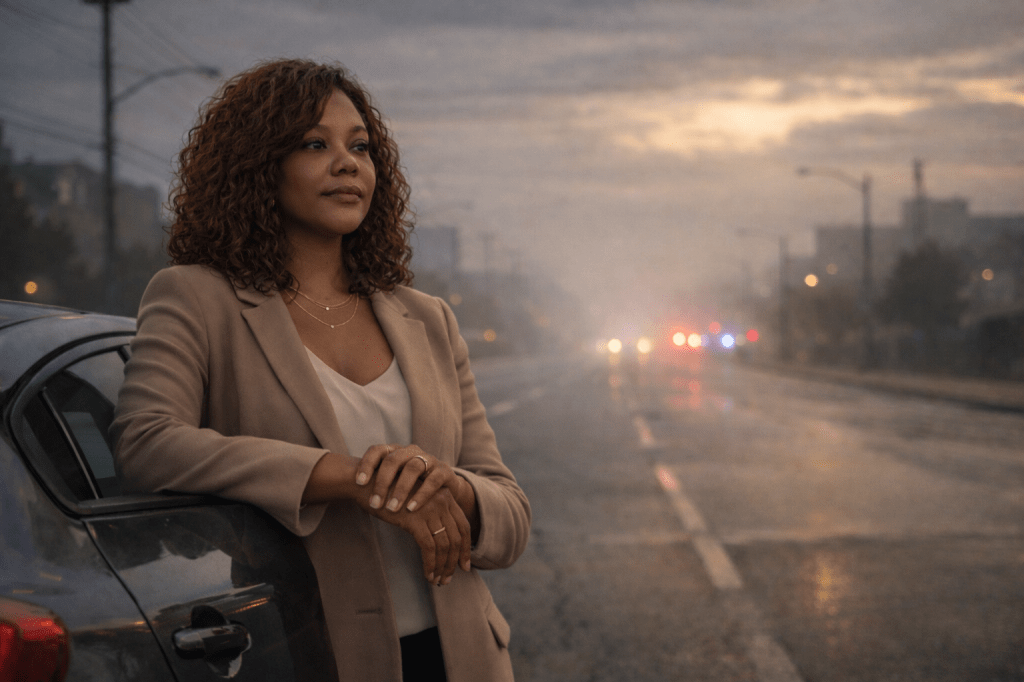
I was driving home, on a familiar stretch of road I had taken countless times. There is a straightaway that forces a right merge after a traffic light. A semi-truck was slightly behind me. I sped up to merge safely.
The semi sped up too.
And then—impact.
A forceful, jarring slam into the back of my car. No slow realization. No time to process. Just the unmistakable violence of metal meeting metal, and the immediate disorientation that follows.
At the exact moment the world was telling us to go home and be safe, I was physically unsafe, emotionally shattered, and unknowingly entering a chapter of grief that would last years.
Shock Is Not Silence—But It Often Looks Like It
Shock is one of the most misunderstood trauma responses. People expect screaming, crying, visible distress. But shock often presents as stillness, compliance, confusion, delayed reaction.
When the police arrived, I was still in shock.
The white officer walked past my car and went directly to the semi-truck. There were two men in the truck. They had already pulled over and were speaking to him. He did not approach me first. He did not ask if I was okay. He did not ask what happened.
Eventually, he came back to ask for my license and registration.
He asked me nothing else.
As I searched for my insurance information, he returned to the truck drivers again. When I finally found it, I got out of the car to look for him.
The accident was determined to be my fault.
That conclusion still bothers me to this day.
Not because accidents can’t happen.
But because I was never asked my story.
The Cost of Not Being Heard
Maya Angelou spoke often—not just about resilience—but about voice. About how being silenced, dismissed, or unseen leaves scars that linger far longer than the original injury.
That day, my voice didn’t disappear.
It was never invited.
In moments of trauma, the body often defaults to compliance as a survival mechanism—especially when authority is present. Many psychologists note that people experiencing acute stress are less likely to advocate for themselves, even when something feels wrong.
I knew something wasn’t right.
I knew the situation wasn’t fully understood.
But I didn’t fight.
And that haunts me.
Not because I failed—but because the system depended on my silence.
When Personal Crisis Meets Institutional Power
Michelle Obama has spoken extensively about navigating systems that were not designed with her in mind—and about the emotional labor required simply to exist within them.
That day, I was not just a woman in an accident.
I was a Black woman in shock.
On the first day of a global crisis.
Processing my mother’s terminal diagnosis.
Standing alone beside my damaged car.
Power dynamics don’t disappear during emergencies.
They become sharper.
The determination of fault wasn’t just a legal conclusion—it became another weight added to a day already collapsing under its own gravity.
Grief Does Not Wait Its Turn
That night, I went home—not to safety, but to reality.
My mother had stage four cancer.
There is no gentle way to receive that information. There is no linear process for what follows. Grief does not knock politely or schedule itself after recovery. It arrives fully formed, unannounced, and unapologetic.
Oprah Winfrey has often described grief as something that reorders your internal world. Not something you “get over,” but something you learn to carry differently over time.
What I didn’t know then was that grief would become the background noise of my life—quiet some days, deafening on others.
And the accident, unresolved and unexamined, became one of the many places where grief lodged itself.
Trauma Compounds—It Does Not Expire
Neuroscientists have found that unprocessed trauma remains stored in the body, often resurfacing years later through anxiety, hypervigilance, physical pain, or emotional shutdown.
The accident didn’t end when the paperwork was filed.
The pandemic didn’t end when lockdowns lifted.
My mother’s diagnosis didn’t pause while I recovered.
Everything happened at once—and nothing fully resolved.
This is the reality many women face: crises layered so tightly together that there is no clean recovery point.
The Strength Myth and the Cost of Endurance
Queen Latifah and Ciara have both spoken publicly about redefining strength—not as silent endurance, but as vulnerability, boundaries, and self-protection.
But society often rewards women for being “strong” in the most harmful way:
By expecting us not to fall apart.
Not to question authority.
Not to demand clarity.
Not to take up space.
I was strong that day in the way women are often forced to be: compliant, quiet, resilient to my own detriment.
Barbara Corcoran frequently speaks about regret not as failure, but as information. Looking back, I don’t regret surviving that day. I regret that I was never given the chance to fully speak.
The Question That Still Lingers
If I had it in me to fight that day, I would have.
But trauma doesn’t ask for permission.
And survival doesn’t always look like resistance.
The lingering question isn’t “Why didn’t I fight?”
It’s “Why did the system not pause to listen?”
That question matters—not just for me, but for anyone who has ever been dismissed during their most vulnerable moment.
What I Know Now
I know now that silence does not mean agreement.
I know now that shock is not consent.
I know now that authority without accountability can deepen harm.
And I know now that telling this story matters.
Because stories create records where systems fail to.
Reclaiming Voice After the Impact
Healing does not always come from justice being served. Sometimes it comes from reclaiming authorship over your own narrative.
Chelsey’s Curations exists because I believe in naming experiences that are often minimized, dismissed, or misunderstood—especially when they happen to women navigating multiple layers of responsibility, grief, and systemic imbalance.
This story is not about blame alone.
It is about acknowledgment.
About reflection.
About learning to speak—even years later.
Closing Reflection
The day the world went home, my life collided with reality in ways I am still unpacking.
But I am here.
I am speaking now.
And I am no longer willing to confuse silence with peace.
If you’ve ever carried an unresolved moment—an accident, a diagnosis, a decision made in shock—know this:
You are not weak for surviving quietly.
And you are not wrong for revisiting it later.
Sometimes, the healing begins when the story is finally told.
A Note From Me to You
If this story stirred something in you, you’re not alone.
Maybe you’ve had a day where everything collapsed at once.
Maybe you stayed quiet when you wanted to speak.
Maybe you’re still carrying a moment that never fully resolved.
I’d love to hear from you—only if and when you’re ready.
- What moment in your life quietly changed everything?
- Was there a time you wish someone had paused long enough to truly hear you?
- What did survival teach you that strength never could?
- Looking back now, what do you understand about yourself that you didn’t then?
Your story matters. Your voice matters. And sometimes, sharing it helps someone else realize they weren’t alone either.
With reflection and care,
Chelsey
Chelsey’s Curations — where lived experience meets meaning



 CHELSEY'S CURATIONS
Leave a comment